
Clinical Trial Site Selection Criteria Used by Sponsors and CROs in India
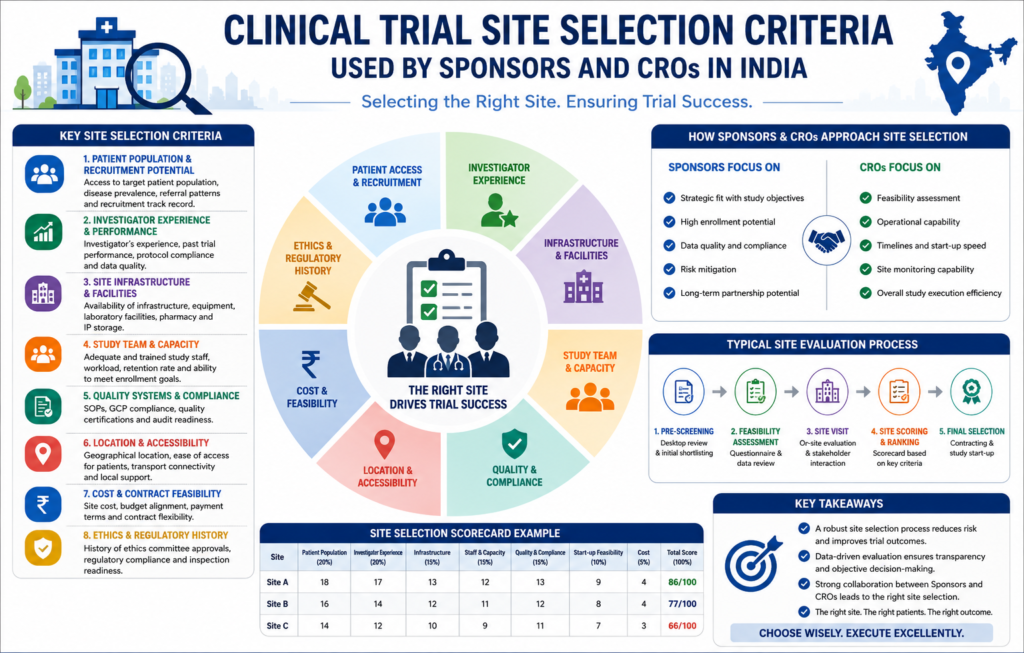
Clinical Trial Site Selection. A sponsor recently approached me after a Phase III global study stalled. They had selected ten high-profile oncology sites in India based on impressive feasibility questionnaires. Six months post-SIV, four sites had zero enrollments. The “paper patients” promised during feasibility didn’t exist in the actual outpatient clinics, and the Principal Investigators (PIs) were over-committed to five other competing global trials. This isn’t a unique failure; it is the standard outcome of selecting sites based on marketing rather than operational reality. Clinical Trial Site Selection In India, site selection is the most significant risk-mitigation step in the study lifecycle. If you get the site wrong, no amount of monitoring or “rescue” activity will bring the timeline back. You are not just looking for a site with a freezer and a centrifuge; you are looking for an ecosystem that can survive a CDSCO audit, meet recruitment targets without compromising GCP, and manage the administrative burden of the New Drugs and Clinical Trials Rules (2019). Executive Summary: Operational Site Comparison Clinical Trial Site Selection Selecting a site based only on the PI’s CV is a recipe for delay. Sponsors must evaluate the infrastructure, the institutional ethics committee (IEC) efficiency, and the actual availability of the study coordinator. Table 1: Site Selection Framework and Impact Analysis Sr. No. Site Category Average Startup (Weeks) Recruitment Reliability Data Quality Rating Regulatory Audit Risk Cost per Patient Staff Turnover EC Meeting Frequency PI Involvement 1 Large Tier-1 Corporate 18–24 High Volume Moderate Low High High Monthly Low 2 Govt. Academic Center 26–40 Very High Variable Moderate Low Low Quarterly Moderate 3 Private Specialist Clinic 12–16 Consistent High Low Moderate Low Monthly High 4 Multi-Specialty Hospital 16–20 Moderate High Low Moderate Moderate Bi-Monthly Moderate 5 Regional Cancer Center 24–30 Very High Moderate Moderate Low Low Bi-Monthly Low Indian Regulatory Approval Process and Selection Bottlenecks Clinical Trial Site Selection The Indian regulatory landscape requires a dual-track mindset. While the CDSCO (Central Drugs Standard Control Organization) has streamlined the DCGI approval process to approximately 30–60 days for global studies, the local site-level bottlenecks remain. A site might have a brilliant PI, but if their Institutional Ethics Committee (IEC) meets once every three months and has an arduous 20-step submission process, your “fast-track” study will sit in a drawer. When we evaluate sites via Oxygen Clinical Research Services India, we look at the EC’s track record of queries. Are they asking relevant safety questions, or are they stalling on administrative trivialities? The New Drugs and Clinical Trials Rules (2019) mandate specific compensation clauses and injury management protocols. Sites that lack a dedicated legal or administrative team frequently struggle to sign Clinical Trial Agreements (CTAs), leading to delays that can exceed three months. Real Operational Insights: What Fails and Why Most feasibility questionnaires are filled out by a junior study coordinator and signed by a PI who hasn’t read the protocol. To find the truth, look at these three indicators: Table 2: Operational Risk Assessment Matrix Sr. No. Risk Factor Probability Impact on Timeline Impact on Cost Mitigation Strategy Data Quality Effect Monitoring Burden Site Type Sensitivity 1 EC Delay High 3–5 Months High Select sites with monthly ECs Minimal High Academic/Govt 2 Staff Turnover Moderate 1–2 Months Moderate Verify site-level SOPs for training Severe Very High Corporate 3 PI Unavailability High Ongoing Low Appoint a strong Co-Investigator High High Tier-1 Private 4 IP Storage Issues Low 1 Month High Temperature log audit during PSSV Severe Moderate Small Clinics 5 Poor Recruitment High Indefinite Severe Patient database verification Low Moderate All Case Studies: Real-World Execution Outcomes Case Study 1: The “Paper Patient” Trap Case Study 2: The EC Administrative Loop Case Study 3: The Data Integrity Crisis Challenges and Mitigation in Indian Sites The biggest challenge is not the science; it is the infrastructure and “trial-readiness.” In India, you will face: Myths vs Reality Common Mistakes Sponsor Mistakes CRO Mistakes Site Mistakes The Counterintuitive Insight: Avoid the “Star” PI Most sponsors chase the “Key Opinion Leaders” (KOLs). In my experience, the KOL is your biggest risk factor. They are in Switzerland for a conference, they are at a national gala, or they are performing surgeries 12 hours a day. They have no time to check the Case Report Forms (CRFs). Instead, select a site where the PI is mid-career, hungry for publication, and actively involved in the daily clinic. This PI will actually see the patient, and that is where data quality lives. Practical Sponsor Checklist Feasibility Stage Startup Stage Execution Stage Regulatory and Compliance Context Navigating the Indian environment requires strict adherence to: For those looking to establish a footprint, understanding the Clinical Research Contact India requirements is the first step in avoiding early administrative rejection. Suggested Infographics (Concept) External References FAQ Section 1. How long does the average site selection and startup take in India? From initial feasibility to Site Initiation Visit (SIV), you should budget 4 to 6 months. While regulatory approval is faster now, the site-level hurdles—EC approvals and CTA negotiations—remain the primary delay factors. 2. Is patient recruitment in India still as fast as it used to be? Yes, but the quality has changed. Regulatory oversight is much stricter. You can still recruit quickly, but you must ensure that every patient is truly eligible and that the consent process is perfectly documented to survive an audit. 3. What is the biggest error made during feasibility? Relying on “database numbers.” Sites see thousands of patients, but only a fraction meet the restrictive inclusion/exclusion criteria of a modern protocol. You must perform an actual “chart review” during feasibility. 4. Are local ethics committees reliable for global trials? Many private and corporate hospitals have highly efficient and ICH-GCP compliant ECs. However, some smaller or older academic centers have committees that are understaffed and slow. Always audit the EC’s SOPs before selecting a site.
